
18k gold on sterling silver, bonded into one sheet.
Bi-metal sheet for jewelers and metalsmiths. One face is 18 karat yellow gold and the other is sterling silver, so a single sheet gives you two surfaces to work. Hallmarked 1/20 18K/Stg GF.
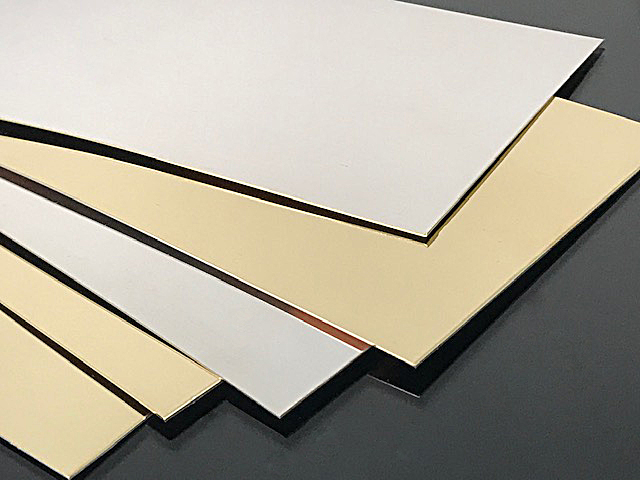
Sheet sizes in stock
Need a size that isn't listed? Call or email and ask.
| Gauge | Sheet sizes | Weight |
|---|---|---|
| 24 gauge | 3 × 3 in, 3 × 6 in, 3 × 9 in, 3 × 12 in | .11159 oz per sq in |
| 20 gauge | 3 × 6 in, 3 × 12 in | .17765 oz per sq in |
To order, call 1-800-710-1050 or email [email protected] for current pricing.
Specifications
Working temperatures and solder for each side of the sheet.
| Hallmark | 1/20 18K/Stg GF |
|---|---|
| Composition by weight | 5.00% 18 karat gold alloy, 95.00% sterling silver |
| Composition by volume | 3.38% 18 karat gold, 96.62% sterling silver |
| 24 gauge layers | .00068 in 18 karat gold, .01942 in sterling silver |
| 18 karat melting range | Solidus 1620 °F (882 °C), liquidus 1715 °F (935 °C) |
| Sterling melting range | Solidus 1435 °F (780 °C), liquidus 1640 °F (890 °C) |
| Reticulation | Between 1600 °F and 1650 °F the silver side begins to flow and reticulate below the gold layer |
| Annealing temperature | 1140 °F to 1300 °F |
| Solder, gold side | 14k or 18k yellow easy (soft) solder |
| Solder, sterling side | Easy or medium silver solder |
| Mechanical properties | Similar to sterling |
| Specific gravity | 10.53718 g per cu cm |
| Density | 5.5516 oz per cu in |
Where bi-metal comes from
Bonding one metal to another with heat and pressure goes back more than 200 years to Thomas Bolsover, a silversmith in Sheffield, England. He was using a copper coin as a shim to hold a silver knife in a vise, and found that after several hours of clamping the copper had fused to the silver. The Old Sheffield Process that came from it is how gold-filled stock is made, and bi-metal sheet is made the same way.
Adapted from The Handy Book of Precious Metals, Handy & Harman.
Open a trade account
Shine Bimetal sells to the trade. Fill in the application and sign it online, and you can download a signed copy for your records.